AI Agents and the New Era of Competition
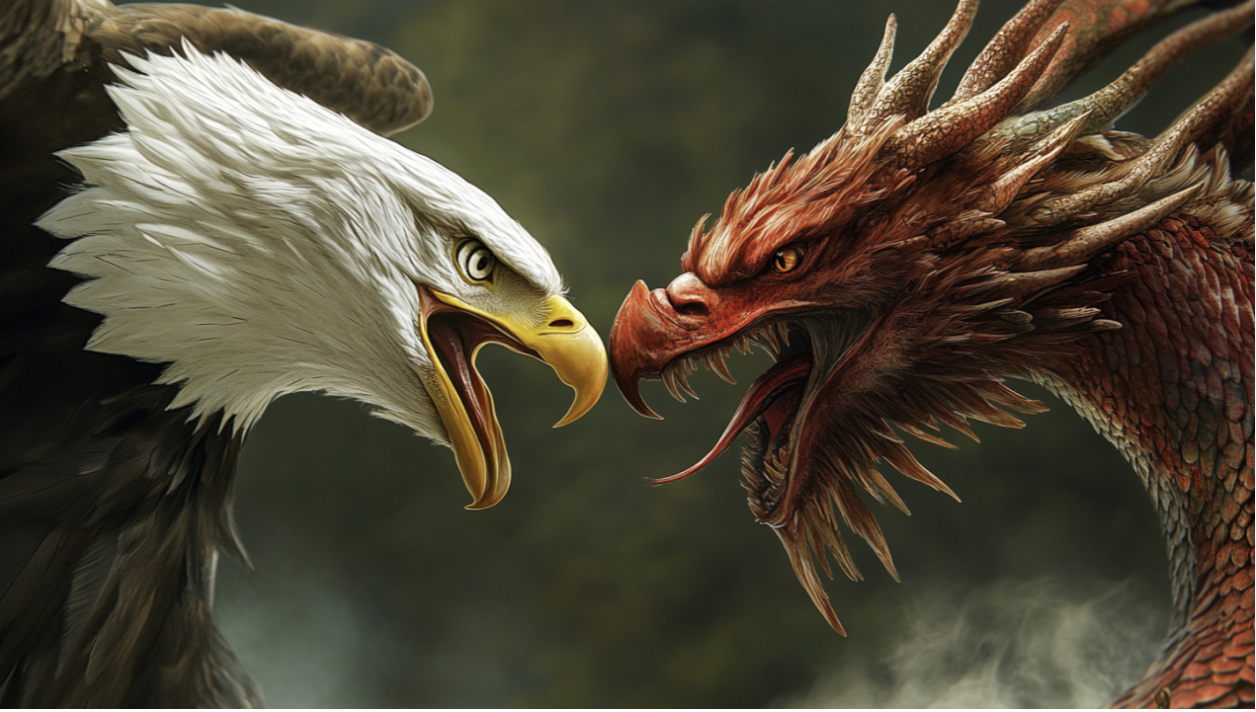
The AI industry is in the midst of an unprecedented arms race, with OpenAI leading in the US and DeepSeek emerging as China's powerful challenger. While OpenAI set the standard with GPT-4, DeepSeek is rapidly reshaping the landscape with DeepSeek-V3 and DeepSeek-R1 models that bring performance, open-weights accessibility, and advanced reasoning capabilities. This is particularly relevant for organizations focused on AI automation.
But this rivalry is more than just about AI, it's about global economic power and geopolitics. DeepSeek's rise has already disrupted the industry, challenging OpenAI's dominance and sparking critical discussions on AI accessibility, national security, and export restrictions.
DeepSeek-V3 & DeepSeek-R1: An Overview
DeepSeek, is a subsidiary of High-Flyer, a hedge fund known for its work in quantitative trading. The CEO of DeepSeek, Liang Feng, has strong Artificial General Intelligence (AGI) aspirations and emphasizes the need for an open AI ecosystem in China. AGI refers to a type of AI that can perform any intellectual task that a human can do. DeepSeek is believed to have around 50,000 GPUs (Graphics Processing Unit), significantly more than the 10,000 NVIDIA A100 GPUs they publicly disclosed in 2021. GPUs (Graphics Processing Unit) serve as the computational backbone for AI model training and inference.
DeepSeek-V3 and DeepSeek-R1 are the latest AI models from DeepSeek. The DeepSeek models are open-weights, with R1 having a very permissive MIT license. DeepSeek-V3, on the other hand, operates under a custom license that is more restrictive than MIT. The DeepSeek custom license has some limitations, similar to the Llama's license, which means it is not fully open-source but still more open than proprietary models like OpenAI's.
The DeepSeek models are designed to push the boundaries of efficiency, reasoning, and transparency in AI development.
DeepSeek-V3: A Powerful Mixture-of-Experts (MoE) Model
DeepSeek-V3 is an AI model based on the MoE architecture, which significantly improves computational efficiency while maintaining high performance. A MoE model is a smart AI system that activates only a subset of the weights to solve different tasks efficiently. In a human brain, different parts or subsets in the brain are activated for different tasks. GPT-4 was one of the first widely deployed MoE models at scale. In DeepSeek-V3, during inference, only 37 billion parameters are activated, while the model has 600 billion parameters.
DeepSeek decided on an open-weights architecture. Anyone can download the weights matrix and run DeepSeek at home. Companies are able to finetune DeepSeek on private data by adding and/or unfreezing weights. This capability is particularly valuable for organizations implementing AI Agents for sales and marketing automation workflows, where domain-specific customization can significantly improve performance.
DeepSeek's proclaimed training cost is USD 5M. This is significantly lower compared OpenAI's cost to train GPT-4. The true training cost of GPT-4 is unknown but OpenAI hinted that it is north of USD 100M. Cost comparisons however, are always tricky as we are not sure what exactly has been costed. Some experts suggest that DeepSeek's figure (USD 5M) might not encompass all expenses, such as data acquisition, engineering, and infrastructure. Nevertheless, DeepSeek models represent a paradigm shift in AI efficiency, challenging the belief that cutting-edge AI requires billion-dollar compute budgets.
DeepSeek-R1: A Leap in Reasoning AI
DeepSeek-R1 builds upon the foundation of DeepSeek-V3 but focuses on reasoning and problem-solving. DeepSeek-R1 should be benchmarked against OpenAI's o3 model.
Key features of DeepSeek-R1 include:
- Explicit chain-of-thought (CoT) reasoning, allowing users to see how the model arrives at its conclusions — OpenAI does not reveal their CoT reasoning!
- Step-by-step structured problem-solving, making it superior for logic-heavy tasks such as coding and mathematics
- Fine-tuned post-training using Reinforcement Finetuning (RFT), which improves reasoning capabilities by evaluating multiple solutions before generating a final answer
DeepSeek models have introduced a new level of competition, particularly against OpenAI's and Meta's offerings. Below is a comparison across several key factors:
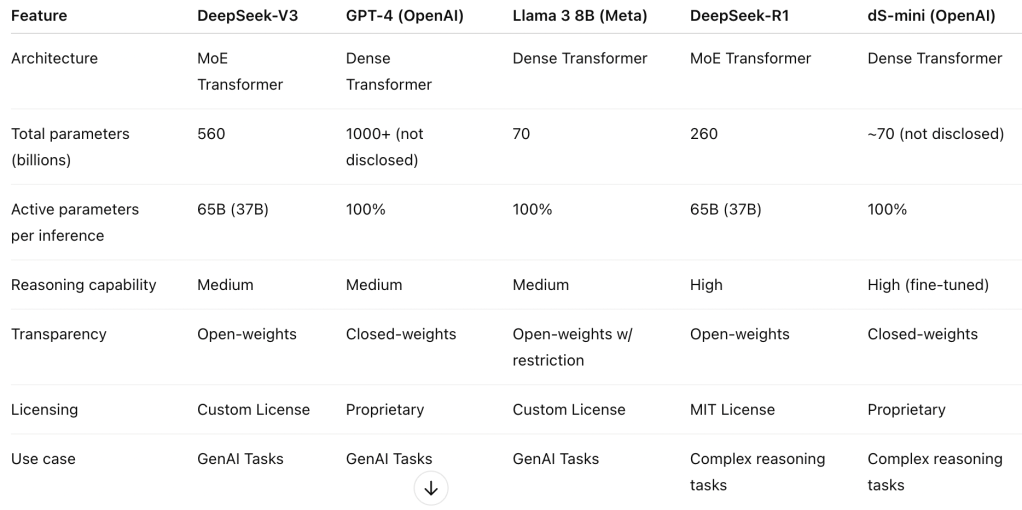
DeepSeek-R1's explicit reasoning process gives it an edge in tasks requiring deep logical analysis, while DeepSeek-V3's MoE approach allows for a significant reduction in compute costs. These capabilities place DeepSeek models at the forefront of AI research, competing directly with companies like OpenAI, Anthropic, xAI and Meta.
Open-Weights vs. Open-Source
One of the most significant discussions surrounding AI today is the distinction between open-weight and open-source AI models. Before December 2024, Llama was the popular open-weights model. Llama's technical report however, has fewer training specifics compared to the DeepSeek report. In addition, Meta's Llama models impose commercial restrictions, making them less flexible than DeepSeek.
Open-weights models provide access to trained model parameters (weights) but does not share the full code or training datasets. Open-source models make their code, training data, and model weights fully available for modification and replication.
DeepSeek-V3 and DeepSeek-R1 fall into the open-weight category, meaning their weights are accessible, but training datasets and methodology are not fully disclosed. This is in contrast to OpenAI's GPT models, which are closed-weight, restricting all external access to their AI systems.
Why Open-weights matters:
- Open-weights AI allows businesses to finetune models for their own applications
- Companies can audit and validate AI behaviour
- Reduces dependence on proprietary AI systems from dominant players like OpenAI.
While true open-source AI remains rare at the cutting edge, open-weight models like DeepSeek represent a step toward greater accessibility in AI development.
The Role of NVIDIA GPUs
The United States has imposed export restrictions to limit China's AI development, focusing on restricting access to high-performance computing resources rather than outright preventing AI model training. Companies like OpenAI and Anthropic view advanced AI capabilities as crucial for military and geopolitical advantages. To maintain its lead, the US government has capped the level of computing power that China can access, making it more challenging for Chinese companies to scale AI models effectively.
The US-China rivalry centers on high-performance GPUs, particularly NVIDIA's chips essential for AI training. The US banned H100 exports to China in September 2022, prompting NVIDIA to develop modified A800 and H800 versions. By October 2023, these were also banned.
NVIDIA then introduced the H20 chip for compliance. The H20 generated $12-15 billion sales in 2024 before new restrictions in April 2025. The new restrictions resulted in an immediate charge of USD 5.5 billion taken by NVIDIA, on top of losing USD 15 billion in potential sales. NVIDIA's China market share dropped from 95% pre-2022 to 50%. Nvidia, however, plans to launch a cheaper Blackwell GPU for China.
Meanwhile, Chinese AI firms have responded by optimizing software to make the most of restricted hardware. DeepSeek trained its models on H800 GPUs before they were banned and developed custom low-level CUDA optimizations to maximize performance. CUDA (Compute Unified Device Architecture) is NVIDIA's parallel computing platform for accelerating AI, graphics, and scientific computing. This has led to a surge in AI efficiency research in China, enabling companies like DeepSeek to remain competitive despite hardware limitations.
China is also working to develop its own AI chips to bypass US export restrictions, though these chips remain less advanced than NVIDIA's offerings. Even with limited access to high-end GPUs, Chinese AI research continues to progress rapidly. The release of DeepSeek-R1 is seen as a milestone in China's AI development, with global implications.
At the same time, AI leaders in the US expect significant advancements toward Artificial General Intelligence (AGI) in the near future. The AI race between the US and China, shaped by NVIDIA's GPUs and strict export controls, is intensifying, with both nations striving for dominance in this transformative technology.
Recent Developments
DeepSeek has released updated versions of its models, including enhancements to DeepSeek-R1, improving reasoning capabilities and performance. These updates may offer additional benefits for enterprise applications. While initially prominent in China, DeepSeek's models have gained attention internationally. However, concerns over data privacy and security have led to scrutiny and restrictions in some countries. DeepSeek-R1 is now available on platforms like Azure AI Foundry and GitHub, facilitating easier integration for enterprises and developers.
Studies have identified safety deficiencies in DeepSeek models, particularly in handling harmful prompts. Organizations must implement appropriate safeguards when selecting and deploying these models. This becomes particularly important for AI content generation applications where content quality and safety standards are critical for business operations.
Rainmakers SG helps small and medium businesses design safe and scalable Agentic AI systems that provide immediate ROI!